
Introduction
Centrifugal fans are the workhorses of industrial ventilation, and in chemical processing, plating, wastewater, and lab exhaust they spend their working lives pulling acid vapour, caustic mist, and solvent fumes through the ductwork. That duty destroys ordinary steel. It is the reason polypropylene fans exist, and the reason the wrong fan fails early—and expensively.
Choose the wrong centrifugal fan type and you risk inefficient airflow, premature failure, and unplanned downtime. In corrosive service, mismatched materials speed deterioration, raise safety risk, and force emergency replacements.
This guide covers the main centrifugal fan types, how each one behaves in a corrosive air stream, and why polypropylene construction is usually what decides whether the fan lasts three years or twenty-five.
Key Takeaways
- In acid and caustic service the material, not the blade design, decides how long the fan survives
- Polypropylene is inert across most of the pH range and corrosion-resistant through its full wall thickness, with no coating to chip or undercut
- Centrifugal fans divide into three blade families: forward-curved, backward-curved, and radial (straight blade)
- Backward-curved wheels in polypropylene are the standard answer for corrosive chemical and fume exhaust
- Radial fans handle heavily contaminated and abrasive streams; forward-curved wheels belong in clean air only
What a Corrosive Air Stream Does to a Fan
A fan on chemical duty is not just moving air. It is running a wet, aggressive gas stream across a wheel spinning at speed, hour after hour, and everything in that stream is looking for a way into the material.
Typical duties that punish equipment:
- Acid pickling, plating, and anodising lines carrying hydrochloric, sulphuric, nitric, and chromic acid vapour
- Scrubber and stripper exhaust where the gas leaves saturated and condenses inside the housing
- Wastewater and digester air carrying hydrogen sulphide, which turns to sulphuric acid on wet surfaces
- Laboratory and pharmaceutical fume extraction with mixed and unpredictable chemistry
- Semiconductor and battery process exhaust with hydrofluoric and other aggressive halides
Two things make this harder than a dust application. Condensate collects in the scroll and sits against the material between shifts, so the attack continues when the fan is off. And the chemistry is rarely one clean compound, so a material chosen for a single acid can still fail on what else is in the stream.

Why Polypropylene Handles What Metal Cannot
Corrosion in a metal fan is an electrochemical reaction: the metal gives up electrons to the acid, salt, or moisture in the gas stream, and the wheel slowly dissolves. Polypropylene has nothing to give. It is chemically inert across most of the pH range, so acid vapour, caustic mist, and plating fumes pass through the fan without attacking the material.
Coated steel is a different proposition, and this is where most premature failures start. A coating is a barrier, and a barrier only works until something breaches it. One particle strike, one pinhole at a weld, one handling scratch during installation, and the gas stream reaches bare metal underneath. Corrosion then spreads beneath the coating where no inspection will catch it until the wheel is already unbalanced.
A polypropylene fan has no coating to breach. The wheel and the housing are the corrosion-resistant material through the full wall thickness, and IPF Colasit welds the construction rather than bolting it, so there are no fasteners or fixing holes for the chemistry to find.
What that changes in service:
- Resistance across the acid and alkali range rather than to one nominated chemistry
- No recoating interval, no touch-up programme, and no hidden undercutting
- Chlorides that pit stainless steel have no effect
- Damage from a knock stays local instead of opening a corrosion path
- Smooth welded internals that shed condensate instead of holding it against the wall
That is the difference between a fan that is consumable and a fan that is infrastructure.
Types of Centrifugal Fans
centrifugal fans differ mainly by impeller blade design. Blade shape sets the pressure range, airflow volume, and tolerance for dirty or corrosive air. On chemical duty the blade choice narrows quickly, because a wheel that traps condensate will fail no matter what it is made of.
Forward-Curved Centrifugal Fans
Forward-curved fans use many small blades that curve in the direction of rotation—the familiar "squirrel cage" look. They move a lot of air at relatively low speed, but static pressure capability is modest compared with other centrifugal types.
They pack the highest blade count into the smallest package for a given airflow and run at lower tip speeds. Efficiency is the trade-off: typically 55–65%, well below backward-curved designs.
Best suited for:
- Clean-air HVAC and low-pressure ventilation (about 3 in. w.g. or less)
- Fan coil units and light commercial air handlers
- Tight mechanical spaces where a compact wheel matters
Use filtered or clean air only. Fines build up on the closely spaced blades, unbalance the wheel, and lead to failure. On acid or caustic fume duty the same close spacing holds condensate against the blade between shifts, so forward-curved wheels are the wrong starting point whatever material they are moulded in.
Strengths and trade-offs:
- Most compact design for a given airflow; quiet at the design point
- Lower first cost and simple construction
- Lowest efficiency, so operating cost runs higher over time
- Rising power curve—motor can overload if system resistance falls below design
- Poor tolerance for dust or sticky particulate

Backward-Curved Centrifugal Fans
When efficiency and stable power draw matter more than minimum wheel size, backward-curved fans are the usual upgrade path. They use fewer, longer blades (typically 8–12) that curve away from rotation. Air enters axially, accelerates along the aerodynamic blade, and converts velocity to pressure in the scroll.
These designs lead the category on efficiency—about 80% static efficiency, with airfoil wheels above 85%. They develop medium to high static pressure, run faster than forward-curved fans, and use a self-limiting power curve that helps prevent motor overload.
Best suited for:
- Industrial HVAC and air handling units
- General manufacturing ventilation and process cooling
- Light to moderate dust collection
- Jobs where energy use and operating cost dominate the decision
- Chemical processing and other corrosive exhaust when the airstream materials are specified correctly
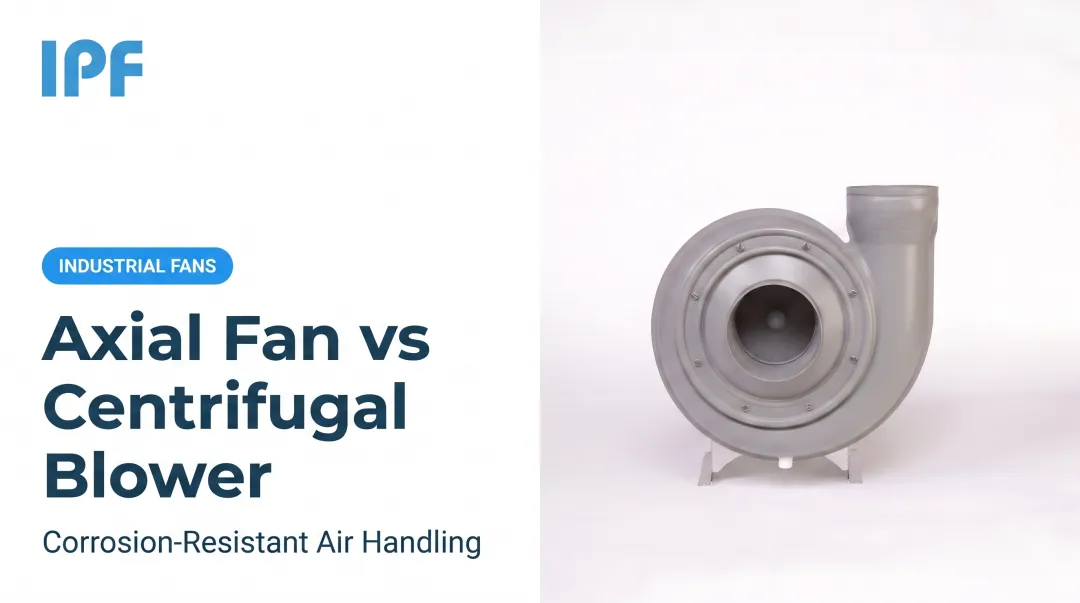
This is the wheel that does most of the work in corrosive service. For chemical processing, wastewater treatment, and laboratory fume exhaust, IPF Colasit builds the backward-curved wheel and housing in solid polypropylene, welded throughout. The open blade spacing sheds condensate instead of trapping it, and the material shrugs off the acid and caustic attack that consumes coated steel in a handful of years. PVC and FRP remain available where a specific chemistry or a higher operating temperature rules polypropylene out.
Strengths and trade-offs:
- Highest efficiency and lower lifetime energy cost despite a higher purchase price
- Stable power curve that resists motor overload; quieter than radial wheels
- Better light-dust tolerance than forward-curved designs
- Larger footprint and higher initial cost than forward-curved fans
- Material choice still decides life in corrosive or high-temperature service
Radial (Straight Blade) Centrifugal Fans
Radial (straight-blade) fans trade peak efficiency for survival in dirty, abrasive, or conveying duty. Straight, paddle-like blades (typically 6–12) extend from the hub at 90 degrees. Air enters axially and is thrown outward by centrifugal force—the simplest, toughest impeller layout in the family.
Wide blade spacing and open geometry favor durability over efficiency. These wheels handle the dirtiest airstreams and can move solid material with the air—conditions that foul or erode forward- and backward-curved designs. They also earn their place where a stream is corrosive and abrasive at once, such as scrubber carryover or filter-house exhaust, and they can be built in polypropylene for that combination.
Best suited for:
- Material conveying and heavy dust collection
- Abrasive or sticky particulate
- High-temperature exhaust and industrial drying
- Wood processing, metalworking, cement, and waste handling
Strengths and trade-offs:
- Rugged, often self-cleaning blade geometry with straightforward maintenance
- Strong tolerance for abrasion, sticky buildup, and high temperature
- Lower efficiency and higher noise than other centrifugal types
- More motor power and larger drives for the same airflow

How to Choose the Right Centrifugal Fan Type
The right centrifugal fan matches airflow, pressure, air quality, environment, efficiency, and space constraints to your application—not price or peak efficiency alone.
Factor 1: Airflow (CFM) and Static Pressure Requirements
Calculate your required volumetric flow rate and total system static pressure, including all ductwork, filters, dampers, and components.
Selection guidance:
- High volume/low pressure (under 3 inches w.g.) → Forward-curved
- Medium-to-high pressure (3-20 inches w.g.) with efficiency priority → Backward-curved
- High resistance with particulates → Radial
One Greenheck case study documented a 20% airflow shortfall requiring 20% higher speed, producing 44% higher static pressure and 73% higher BHP. Always calculate installed-system resistance, not just laboratory fan ratings.
Factor 2: Air Quality and Particulate Loading
Assess whether your air stream is clean, lightly dusty, or heavily contaminated. This is the primary selection criterion that eliminates unsuitable fan types.
Decision tree:
- Clean air (filtered) → Forward-curved or backward-curved
- Lightly dusty, non-sticky particulates → Backward-curved
- Heavily contaminated, abrasive, or sticky materials → Radial only
Forward-curved fans fail quickly in any particulate stream; radial is the only practical choice for abrasive or material-laden air.
Factor 3: Operating Environment and Material Compatibility
Consider temperature extremes, corrosive gases, moisture, and chemical exposure. Standard steel construction fails rapidly in chemical processing, wastewater treatment, and plating operations.
Material options for corrosive environments:
- Polypropylene: The default for acid, caustic, and plating fume service. Inert across most of the pH range, corrosion-resistant through the full wall thickness, unaffected by the chlorides that pit stainless steel, and welded rather than bolted so there are no fixing points to attack
- PVC and FRP: Alternatives where a particular chemistry or a higher operating temperature puts polypropylene outside its window
- Stainless steel 316: Moderate corrosion resistance only. Reasonable for marine or salt exposure, but not a substitute for thermoplastic in concentrated acid fume
Research shows corrosion-resistant fans can last 10-15+ years versus 3-5 years for coated carbon steel in harsh service. IPF Colasit thermoplastic fans regularly deliver client-reported service lives of 25 years or more in corrosive gas streams.
Factor 4: Energy Efficiency and Long-Term Operating Costs
Calculate total cost of ownership including energy consumption over equipment lifespan. The DOE's formula uses fan BHP, motor efficiency, annual operating hours, electricity price, and load factor to estimate annual electricity cost.
Backward-curved fans cost more initially but save substantially on energy versus forward-curved or radial designs operating continuously. A 10-15% efficiency gain can pay back the initial premium in 1-3 years.
Factor 5: Space Constraints and Noise Limitations
Evaluate available installation space and acceptable noise levels.
Size hierarchy: Forward-curved (most compact) → Backward-curved → Radial (often largest)
Noise hierarchy: Backward-curved (quietest) → Forward-curved → Radial (loudest)
Consider acoustic enclosures if noise is critical. Verify sound levels using AMCA 300 certified ratings at your actual operating point, not catalog maximums.
Work the factors in order: define CFM and static pressure, screen by air quality, then lock material, efficiency, and footprint. That sequence narrows the field to a fan type that will hold up in real service—not just on the curve sheet.

Common Mistakes When Selecting Centrifugal Fans
Even experienced buyers make costly specification errors. These three show up most often on industrial projects.
Mistake 1: Choosing based on initial cost alone
A cheaper fan that fails in 3 years or costs thousands more in electricity is not economical. Always calculate total cost of ownership: initial equipment, energy, maintenance, and replacement.
Mistake 2: Selecting the wrong blade type for air quality
Using forward-curved fans with any particulate matter causes rapid fouling and failure. Expensive backward-curved fans also waste money where radial designs belong, because abrasive dust erodes the blades. Match blade type to actual air quality first, then optimize other factors.
Mistake 3: Ignoring material compatibility and operating environment
Specifying carbon steel or coated steel for corrosive chemical applications leads to rapid failure, safety hazards, and emergency replacements. Match the material to gas stream chemistry, temperature, and moisture: polypropylene handles the acid and caustic exhaust that destroys metal, with PVC and FRP covering the chemistries and temperatures that fall outside it. When in doubt, request a written compatibility review from the manufacturer for your actual concentration and temperature conditions.
Conclusion
Centrifugal fans handle industrial ventilation across a wide range of conditions. Forward-curved, backward-curved, and radial blade designs each suit different pressure ranges, air quality, and operating environments.
Matching fan type to the application matters, but on chemical duty the material is what settles the outcome. A welded polypropylene wheel and housing will outlast coated steel several times over in acid, caustic, and plating exhaust, and it does so without a recoating programme. Time spent on material selection upfront prevents years of downtime and avoidable replacement costs.
Frequently Asked Questions
How long does a polypropylene centrifugal fan last in acid service?
Coated carbon steel typically gives 3–5 years in aggressive chemical exhaust before corrosion forces replacement. IPF Colasit polypropylene fans regularly reach client-reported service lives of 25 years or more in the same duty, because there is no coating to breach and no bare metal underneath it.
Why choose a polypropylene fan over coated steel?
A coating is only a barrier, and it protects the steel underneath until something chips, scratches, or pinholes it. After that the acid reaches bare metal and spreads beneath the coating unseen. Polypropylene is corrosion-resistant through its whole thickness, so surface damage stays local and there is no recoating interval to manage.
Which chemicals and acids can a polypropylene fan handle?
Polypropylene stands up to most inorganic acids and alkalis, including hydrochloric, sulphuric, nitric, chromic, and phosphoric acid vapour, plus caustic soda mist and hydrogen sulphide. Strong oxidisers and some solvents at elevated temperature fall outside its range, which is where PVC or FRP is specified instead. Always confirm against your actual concentration and operating temperature.
How do I know if I need a backward-curved or radial centrifugal fan?
If your application involves clean to moderately dusty air and energy efficiency matters, choose backward-curved for roughly 80% efficiency. For heavily contaminated, abrasive, or sticky particulate, choose radial for durability and self-cleaning—even when peak efficiency is lower.
What materials should I specify for centrifugal fans in corrosive environments?
Specify polypropylene for most acid, caustic, and plating fume service: it resists attack through the full wall thickness and delivers 20–25+ year service life in chemical, wastewater, and lab fume duty. PVC or FRP covers chemistries and temperatures outside the polypropylene window, and stainless steel 316 suits only moderate corrosion such as marine or salt exposure. Always verify compatibility for your chemistry, concentration, and temperature.