
The choice isn't cosmetic. It affects capital cost, ongoing maintenance, corrosion resistance, and whether you'll pass your next emissions test. Get it wrong, and you're looking at compliance failures, unplanned downtime, or equipment that corrodes through in a few years instead of lasting decades.
This guide breaks down how each technology works, where each one excels, and how to think through the decision for your specific gas stream.
TL;DR
- Wet scrubbers use liquid to capture acid gases and particulates; effective, but need water and wastewater handling
- Dry scrubbers use dry sorbent with no liquid; smaller footprint, no wastewater, lower fine-particulate efficiency
- Choose based on pollutant type, water availability, emission limits, and disposal infrastructure
- Construction material (polypropylene vs. metal) determines how long either system survives in corrosive service
Wet vs Dry Scrubbers: Quick Comparison
Cost
- Wet: Higher upfront capital cost; reagent efficiency often lowers long-term operating expense
- Dry: Cheaper to install; recurring sorbent purchase and disposal costs add up over time
Removal Efficiency
Efficiency numbers vary widely by design and pollutant:
- Wet venturi scrubbers: >99% for particulate matter
- Wet packed-bed/tray towers: typically 95-99% removal for industrial acid gases (EPA Control Cost Manual)
- Dry sorbent injection plus fabric filter: around 90% HCl removal per EPA estimates
- Dry circulating dry scrubbers: 95-98% SO2 removal in coal-plant applications

Water Usage & Waste
- Wet: Requires water or liquid reagent; generates wastewater or blowdown that needs treatment
- Dry: No water needed, but produces solid waste that may require hazardous-material disposal
Maintenance & Durability
- Wet: Regular monitoring of pH, spray nozzles, and packing; polypropylene construction extends service life in corrosive gas streams
- Dry: Fewer moving parts, but sorbent replenishment and filter maintenance add labor many facilities underestimate
Best-Fit Applications
- Choose wet for tight emission limits, high-humidity gas streams, or multiple pollutants needing simultaneous removal
- Choose dry for water-scarce regions, more permissive limits, or tight floor space
What Is a Wet Scrubber?
A wet scrubber uses a liquid medium (water, caustic solution, or another reagent) sprayed or circulated through packing material to capture and neutralize pollutants from a gas stream. Gas passes through the liquid contact zone; particulates get trapped, and acid gases react chemically with the solution.
The core benefit is high removal efficiency across both particulate matter and gas-phase pollutants simultaneously. That dual capture keeps facilities clear of failed emissions tests, downtime, and re-permitting costs.
Common configurations include:
- Packed bed scrubbers: gas flows through packing material wetted with scrubbing liquid
- Venturi scrubbers: high-velocity gas forces intimate contact with liquid droplets
- Spray towers: simpler design, lower efficiency, better for lighter particulate loads
- Caustic scrubbers: sodium hydroxide solution targets acidic gas streams specifically

Use Cases of Wet Scrubbers
Wet scrubbers dominate in chemical processing, plating, semiconductor fabrication, and wastewater treatment — anywhere acid gases and corrosive fumes are a constant byproduct.
A 2023 Monroe Environmental case study documented a 30,000-CFM horizontal packed-bed scrubber serving semiconductor chip-cleaning operations. The system handled HF, SO2, HCl, and H3PO4 acid gases using fresh water with chemical treatment. Result: 98% destruction and removal efficiency for toxic compounds, meeting the facility's EPA permit requirement.
Material choice decides how long that performance lasts. Polypropylene and FRP resist corrosion through the full wall thickness instead of a surface coating, which fails once it chips or pinholes and lets corrosion spread underneath unseen.
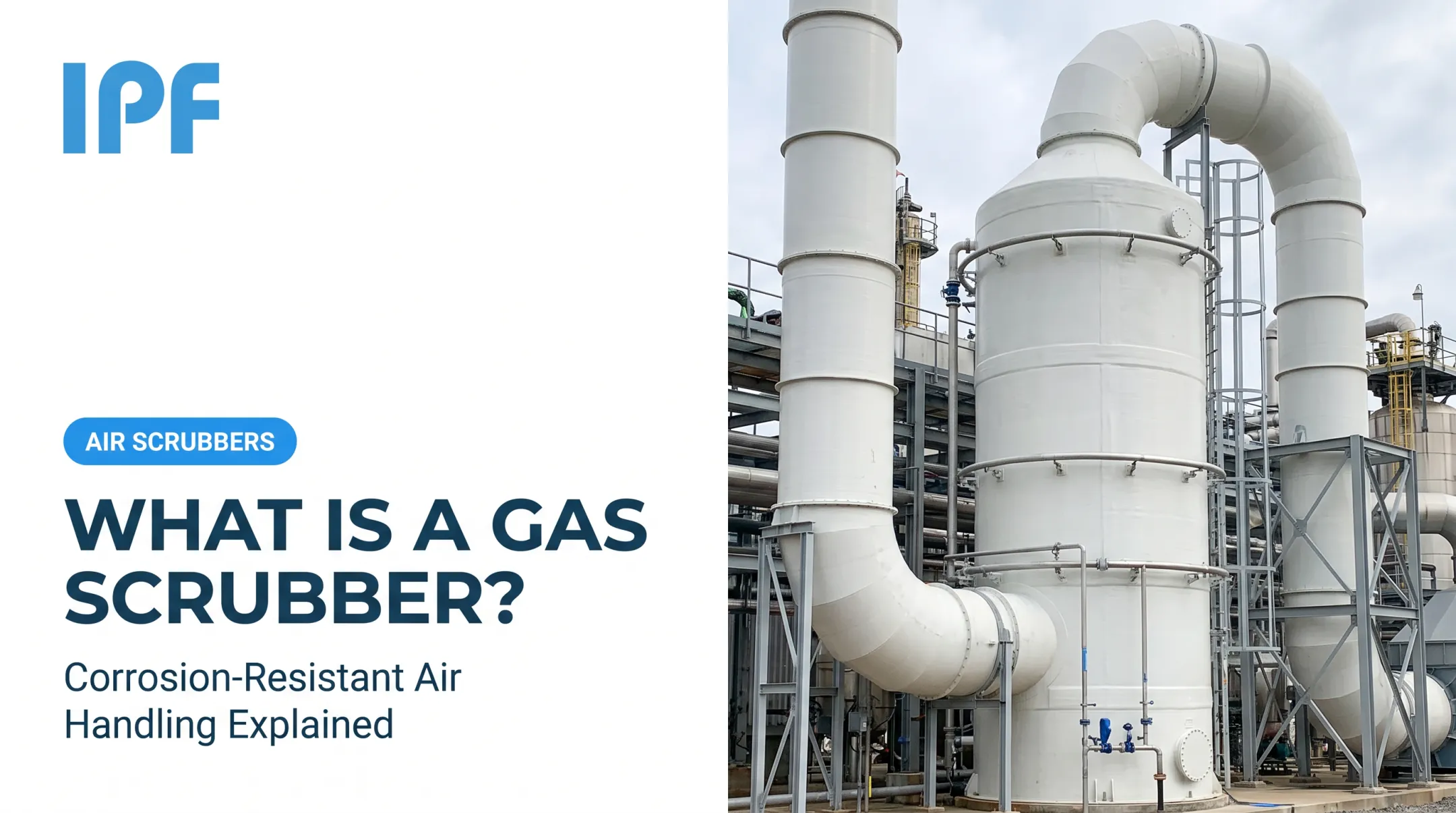
IPF Colasit builds wet packed-column scrubbers in vertical and horizontal configurations from PVC or polypropylene, with PVDF and other specialty plastics for tougher chemistries. Mist eliminators capture liquid particulates, and recirculating tanks can mount remotely to guard against freezing in colder climates.

What Is a Dry Scrubber?
A dry scrubber injects a dry sorbent — hydrated lime, sodium bicarbonate, or activated carbon — directly into the gas stream. The sorbent reacts chemically with or adsorbs pollutants, then filtration captures the spent material.
The main advantage: zero water consumption and zero wastewater treatment. That's a real advantage for facilities in water-scarce regions or anywhere liquid-waste infrastructure is limited or expensive to permit.
Two common approaches:
- Dry sorbent injection (DSI) systems — sorbent is injected upstream of a filtration device
- Fixed sorbent beds — gas passes through a stationary bed of reactive material
Sorbent choice creates a cost-versus-efficiency tradeoff. Hydrated lime typically requires a higher stoichiometric ratio to achieve target removal, while sodium bicarbonate tends to react more efficiently at lower feed rates.
That tradeoff matters most when matching a dry scrubber to the right exhaust stream.
Use Cases of Dry Scrubbers
Dry scrubbers fit best in cooler, drier exhaust streams with more permissive emission limits — such as certain manufacturing operations and waste-to-energy facilities.
A documented test at the WCA Hospital medical-waste incinerator in Jamestown, New York (October 1995) offers concrete numbers. Under bicarbonate conditions, the system achieved roughly 95% HCl removal and 76% SO2 removal.
Switching to lime pushed results higher, at a steeper stoichiometric cost:
| Sorbent condition | HCl removal | SO2 removal | Stoichiometric ratio |
|---|---|---|---|
| Bicarbonate | ~95% | ~76% | 1.2 |
| Lime | 97.5% | 79% | 3.7 |

Note: these are test-specific figures from a single facility over three days, not universal benchmarks. Actual sorbent consumption always depends on your specific gas concentration and required removal rate.
Wet vs Dry Scrubbers: Which Is Better for Your Facility?
There's no universal winner. The decision comes down to five factors:
- Emission limits: tighter limits generally favor wet systems
- Gas temperature and humidity: wet scrubbers handle high-humidity, water-soluble pollutants well
- Water availability: dry scrubbers win where water is scarce or expensive
- Waste disposal infrastructure: solid sorbent waste versus liquid wastewater treatment
- Pollutant concentration and mix: multiple simultaneous pollutants often favor wet systems Choose wet if you face tight emission limits, high-humidity gas streams, or need to remove multiple pollutants at once. Choose dry if water is scarce and your permit limits have some breathing room. Some facilities split the difference with hybrid systems: dry sorbent injection for bulk pollutant removal, then a wet polishing scrubber for final compliance margin. This pairs dry-treatment cost savings with wet-scrubber precision on the back end.
Why Material Choice Matters as Much as Scrubber Type
Scrubber type gets you to compliance. Construction material decides whether that system survives the gas stream. For corrosive service, material often matters more than wet vs. dry. A metal scrubber with a protective coating fails as soon as the coating chips. A wet scrubber in the same build fails faster, because liquid contact accelerates any coating breach. IPF Colasit has supplied polypropylene, PVC, and FRP ventilation equipment to more than 40,000 facilities across North and South America since 1948. In that span, material choice—not just system type—has been what separates equipment that lasts about 5 years from units that run 20-plus. A practical scenario: A chemical processing plant runs a metal-bodied scrubber with an internal protective lining. When routine wear opens a pinhole, corrosion spreads under the lining unseen until a structural failure forces an emergency shutdown. A polypropylene or PVC vessel removes that failure mode. The wall resists acid or caustic attack through its full thickness, not only at the surface. Before you lock a scrubber type or material, have a specialist review your chemical list, concentrations, and required removal percentages.
Conclusion
The right scrubber depends on your site conditions, not a universal ranking. Match the design to your pollutant mix, water access, emission limits, and disposal infrastructure. Wet systems generally lead on removal efficiency and multi-pollutant versatility; dry systems lead on water conservation and footprint.
Corrosion-resistant materials such as polypropylene help that equipment last decades instead of years in chemical service. Before you commit, lock down the process basics: chemical list, concentrations, gas temperature, and required removal rate.
Frequently Asked Questions
Are wet or dry scrubbers better?
Neither is universally better. Wet scrubbers generally achieve higher removal efficiency for acid gases and particulates, while dry scrubbers suit water-scarce or space-constrained facilities better.
What is the difference between wet and dry scrubbers?
Wet scrubbers use liquid to capture pollutants; dry scrubbers use a dry sorbent injected into the gas stream. This difference drives cost, removal efficiency, and the type of waste each system produces.
What are wet scrubbers used for?
Wet scrubbers remove acid gases, particulates, and odors from industrial exhaust streams. They're common in chemical processing, plating, and wastewater treatment facilities.
What are dry scrubbers used for?
Dry scrubbers suit facilities needing water conservation and a smaller equipment footprint. They effectively remove gases like SO2 and HCl without generating wastewater.
How effective are wet scrubbers?
Wet scrubbers typically achieve 95-99% removal for acid gases in most industrial applications. Actual performance depends on gas-liquid contact time and how stable the gas concentration and flow rate are.
What is the liquid used in a wet scrubber called?
It's called the scrubbing liquid or scrubbing solution. Common choices include plain water or a caustic solution like sodium hydroxide, depending on the target pollutant.